Thursday, June 9, 2016

Barbados

In honour of this blog's sixth birthday, a blast from the past! This card from the archives was sent to me by my Mum when my postcard collection was really in its infancy, just a handful of cards tacked up to my bedroom wall. My Mum, well-travelled lady that she is, has contributed considerably to my collection, and I can never thank her enough for taking time out of her holidays to track down stamps, cards and errant post offices to indulge my postcard folly. Merci bien, maman!

Card shows Harrismith Beach on the southeast coast of Barbados.

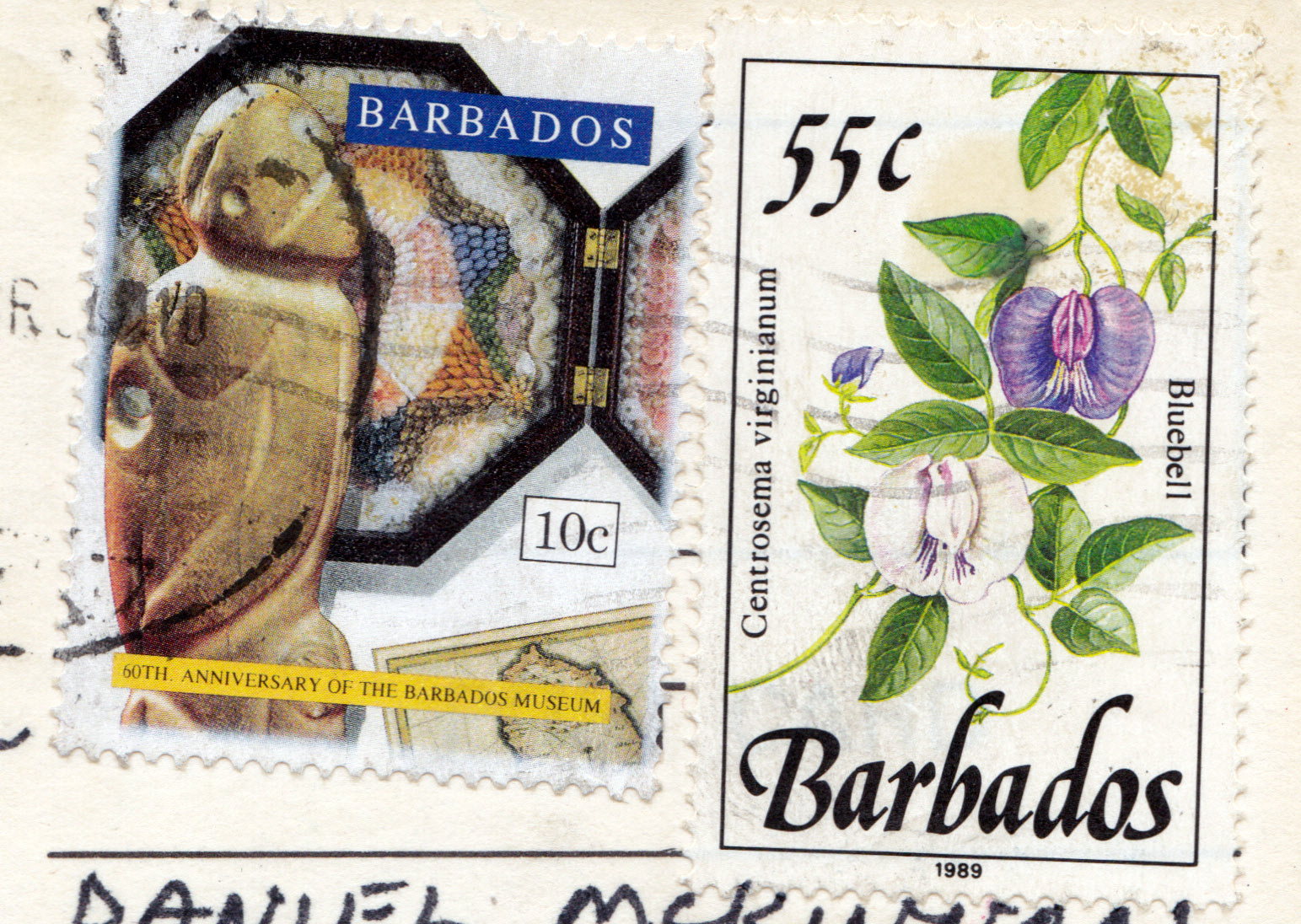
Stamp on the left commemorates the 60th anniversary of the founding of the Barbados Museum in 1933. Stamp on the right from the 1989 definitive set of 16 features Centrosema virginianum, or wild pea, a common vine throughout most of the Americas.
Friday, May 13, 2016

British Indian Ocean Territory

Postcard of Diego Garcia, the largest island in the British Indian Ocean Territory. While the island had previously been the home of a small number of copra plantation workers and their families, they were all forcibly removed between 1968 and 1973 and deported to Mauritius and the Seychelles so that the British government could build a joint military base with the United Stated. 

In 2019, this action and continued British administration of the archipelago were deemed illegal by the International Court of Justice in The Hague, a ruling the United Nations General Assembly supported. The British government, however, dismissed the ruling as not legally binding. 


Stamp from the 2004 definitive series shows a bar-tailed godwit (Limosa lapponica), a large migratory wadering bird that lives in the Arctic coasts and tundra from Scandinavia to Alaska, and overwinters on coasts in temperate and tropical regions of Australia and New Zealand. The migration of the subspecies Limosa lapponica baueri across the Pacific Ocean from Alaska to New Zealand is the longest known non-stop flight of any bird, and also the longest journey without pausing to feed by any animal. The round-trip migration for this subspecies is over 29,000 km.


Wednesday, May 11, 2016

Turkey

Postcard showing Sultan Ahmed Mosque and the Sea of Marmara beyond. It was built between 1609 and 1619 by Sultan Ahmet I, who decided to build a large mosque in Istanbul to reassert Ottoman power following losses in Central Europe and Persia. It incorporates some Byzantine Christian elements of the neighboring Hagia Sophia with traditional Islamic architecture and is considered to be the last great mosque of the classical period. Part of the Historic Areas of Istanbul World Heritage site. Many thanks and teşekkürler to my Mum for sending this to me while on holiday.

Stamp on the left is the 1998 definitive of Kemal Atatürk, seen as the founder of modern Turkey (and a first-rate Dracula impersonator, by the looks of it). Stamp on the right is from a 2000 set of four about crocuses, and features the snow crocus, Crocus chrysanthus. It is native to Turkey and the Balkans and flowers very early in the spring, often pushing up through the snow.

Monday, May 9, 2016

Malta

Multiview postcard of Malta, showing the country's namesake Maltese Cross, the harbour of capital city Valetta, with fortifications forming part of the City of Valletta World Heritage site, and some traditional wooden fishing boats. Thank you and grazzi ħafna to friend Sam who went to Malta to visit relatives.

Stamps are from a 2002 set of four on endangered species, showing seahorses of the Mediterranean. Shown are the long-snouted seahorse, Hippocampus guttulatus, and the short-snouted seahorse, Hippocampus hippocampus, both of which live in the waters around Malta.

Tuesday, January 12, 2016

Ross Dependency

My second attempt at getting a card from Ross Dependency, with a pretty spectac payoff with this card of an explorer from the 1910–1913 Antarctic Expedition sledding past a glacier in front of Mount Erebus. Mount Erebus is the most southerly volcano in the world and, despite it’s remote location, is regularly studied by the nearby McMurdo and Scott research stations on nearby Ross Island.

This completes my collection of Antarctic postal agencies. It's the first complete continent in my collection! Perhaps not the greatest feat when there are just four postal agencies for the continent (Australian Antarctic Territory, British Antarctic Territory, French Antarctic and Southern Lands, Ross Dependency), but my first continent nonetheless! :-)

Quite interestingly for avid postcards nerds like myself, it would seem that the postcard actually did make it all the way to Antarctica, judging by all the extra expedition stamps that made it on to the card. — Ross Dependency is New Zealand’s Antarctic territory. In the past, Ross Dependency post was all processed in Christchurch, on mainland New Zealand, and was never sent for processing in Antarctica. Even if the mail was actually send from an Antarctic research base, post was sent to Christchurch (and cancellation stamps would say “Christchurch”). Now, the cancellation says “Ross Dependency” and has come along with stamps from New Zealand’s Scott Base. Colour me one happy postcard camper!

Georgia

Postcard of Tbilisi city centre, capital of Georgia, a country that shouldn't have been that hard to add into to collection – I've had Armenia and Azerbaijan for years – but has eluded me until now. Many thanks and მადლობა to friend Andy who was in Georgia on holiday. Card shows a part of the Tbilisi Historic District site on Georgia's Tentative List for World Heritage, and the undulating green Bridge of Peace that links the old and new parts of the city.

Stamp is from the 2012 Europa series promoting tourism and features the Gergeti Glacier on Mount Kazbek, one of the highest in the Caucasus Range.

Friday, November 13, 2015

Turkish Republic of Northern Cyprus

This card shows Lala Mustafa Pasha Mosque – originally known as Saint Nicholas's Cathedral – in Famagusta, Northern Cyprus. It was consecrated as a Catholic cathedral in 1328 and was converted into a mosque after the Ottoman Empire captured Famagusta in 1571. It remains a mosque to this day. The building strongly resembles Reims Cathedral and its Rayonnant Gothic style is quite rare outside of France.

Turkish Republic of Northern Cyprus has eluded me for quite a long time, so a massive "thank you" is due to Rosaleen and John, my better half's mother's neighbours, who took time out of their holiday and looked past our very tenuous connection to send this card to me. And another big thanks to Annette for talking me up to the neighbours and arranging for this card to be sent. I'm forever grateful to you all.

Information about Turkish Republic of Northern Cyprus stamps is rather hard to come by. Beyond saying that they were released in 2015 and, quite clearly, feature a dog, not much more I can add. Cute dog though.

Friday, October 9, 2015

Norway

Happy World Post Day! World Post Day is celebrated every year on 9 October, to commemorate the foundation of Universal Postal Union (UPU) in 1874 in the Swiss capital, Bern.

To celebrate, a postcard of Nærøyfjord, a branch of Sogne fjord, the largest fjord in Norway and the longest in the world. The fjord is quite narrow and picturesque – said to be the inspiration for Arendelle in Frozen. It is part of the West Norway Fjords World Heritage site. Tusen takk to my Mum for sending this card to me on her recent cruise of the Norwegian coast.

Permanent rate stamp from 2013 set of six featuring tourism activities. Pictured is whitewater rafting on the Sjoa River in Central Norway.

Sunday, October 4, 2015

Suriname

Postcard of Paramaribo, the capital of South America's only Dutch-speaking country. It's also home to nearly half of the entire population of the country. The city was founded in 1603 and switched between Dutch and English control several times in its early history. The historic inner city of Paramaribo is a World Heritage Site (although I'm not entirely sure that is pictured here). Many thanks and dank je to Sherwin for swapping with me!

Stamps on the left are from a 2008 set of five on local birds. Pictured is a white-necked jacobin, Florisuga mellivora, a large hummingbird common to northern South America. Stamps on the right feature another hummingbird found in Suriname's jungles, the grey-breasted sabrewing, Campylopterus largipennis. From the 1977 definitive set.

Saturday, October 3, 2015

Peru

Postcard of a site that needs hardly and introduction, Machu Picchu. Built by the Inca around 1450 and abandoned around the time of the Spanish Conquest, it is now one of the New Seven Wonder of the World and a World Heritage site. Muchas gracias to my Mum for sending this to me while on holiday in South America.

The stamp, issued in 2009, commemorates the National Archaeology, Anthropology, and History Museum of Peru. Founded in 1826, it is the largest and oldest museum in Peru and covers the entire human history of the country.

Wednesday, August 12, 2015

Cambodia III

Postcard showing the National Museum in the Cambodian capital of Phnom Penh. The Museum was open in 1920 by the French colonial government and houses the world's largest collection of Khmer art. It was shut and abandoned during the Khmer Rouge period from 1975 to 1979. When it was reopened, the roof had rotted in places and it housed a huge colony of bats which were only able to be completely removed over the course of some 15 years.

Stamp issued in 2001 commemorating the 80th birthday of then King Sihanouk.

Monday, July 27, 2015

Trinidad and Tobago

Postcard showing Carnival in Trinidad, the island's most important celebration and one of the largest Carnivals in the Caribbean. Many thanks to my Uncle Pierre and Aunt Ginette for sending it to me. – Despite the fact that the Caribbean is a popular place for holidaying Canadians, it's certainly one of the biggest black holes in my collection. Any Caribbean friends and readers, feel free to help me out. ;-)

Stamps from the 1990 definitive set featuring local birds. Pictured here is the bananaquit, Coereba flaveola, a common bird found in tropical South America and the Caribbean.

Wednesday, July 15, 2015

Jersey

Postcard showing Mont Orgueil Castle in Jersey. Construction of the castle began in 1204 and it continued to be used as a fortification until the invention of gunpowder made it obsolete. Walter Raleigh, of privateer fame and Governor of Jersey in 1600, rejected a plan to demolish the castle and recycle the stone for new fortifications, saying "twere pity to cast it down". It was then variously used as a prison and military barracks until it was turned into a museum in 1923.

Stamp on the left from the 2005 definitive series of wildflowers, featuring common knapweed, Centaurea nigra, a common plant in Europe. Stamp on the right from the 2011 Europa series on forests, a set of four featuring local trees, pictured English oak, Quercus robur, a very long-lived tree species found throughout Europe.

Tuesday, July 14, 2015

New World Heritage sites 2015

As this year's World Heritage Committee meeting wraps up in Bonn Germany, a big congratulations to the 24 new sites and three extensions that were inscribed on the World Heritage list, bringing the total number of Sites to 1031, in 163 countries. Special congratulations to Jamaica for adding its first site to the list, Blue and John Crow Mountains, and to my adopted home, Singapore, for adding its first site to the list as well, the Singapore Botanic Gardens.

There had been a bit of controversy surrounding the Committee meeting as there was a big push to put Australia's Great Barrier Reef site on the List of World Heritage in Danger following the approval of large-scale development and mining plans on the near shore and the deterioration in reef health. In the end, it was not placed on the list, but UNESCO basically said "We're watching you". I was also a bit surprised not to see Pimachiowin Aki back up for consideration. Pimachiowin Aki is a large stretch of pristine boreal forests in Northern Central Canada that includes the ancestral lands of several indigenous people. Listing was deferred at the 2013 Meeting to give Canada time to improve certain aspects of the bid. Given our current government's rather dreadful attitude towards indigenous people, I'm not surprised they didn't make any efforts to do so. What a pity! Hopefully things will improve following our national elections in the autumn.

More information all all the new sites from UNESCO's site here.

Aqueduct of Padre Tembleque Hydraulic System (Mexico)
Arab-Norman Palermo and the Cathedral Churches of Cefalú and Monreale (Italy)
Baekje Historic Areas (South Korea)
Baptism Site “Bethany Beyond the Jordan” (Al-Maghtas) (Jordan)
Champagne Hillsides, Houses and Cellars (France)
Christiansfeld, a Moravian Church Settlement (Denmark)
Climats, terroirs of Burgundy (France)
Cultural Landscape of Maymand (Iran)
Diyarbakır Fortress and Hevsel Gardens Cultural Landscape (Turkey)
Ephesus (Turkey)
Fray Bentos Cultural-Industrial Landscape (Uruguay)
Great Burkhan Khaldun Mountain and its surrounding sacred landscape (Mongolia)
Necropolis of Bet She’arim: A Landmark of Jewish Renewal (Israel)
Rjukan–Notodden Industrial Heritage Site (Norway)
Rock Art in the Hail Region of Saudi Arabia (Saudi Arabia)
San Antonio Missions (United States of America)
Singapore Botanical Gardens (Singapore)
Sites of Japan’s Meiji Industrial Revolution: Iron and Steel, Shipbuilding and Coal Mining (Japan)
Speicherstadt and Kontorhaus District with Chilehaus (Germany)
Susa (Iran)
The Forth Bridge (United Kingdom)
The par force hunting landscape in North Zealand (Denmark)
Tusi Sites (China)
Blue and John Crow Mountains (Jamaica)

Thursday, June 4, 2015

South Korea

Postcard of the Gyeonghoeru Pavilion (경회루) in the Gyeongbokgung Palace (경복궁), one of the former royal palaces of the Joseon dynasty. Originally built in 1395 and reconstructed at various times, in the early twentieth century, much of the palace was systematically destroyed by Imperial Japan. The Gyeonghoeru Pavilion is one of just a handful of buildings to have survived, although there is now a large-scale restoration project to restore the Palace to its original form.

Had a bit of trouble finding info about these stamps, but the one on the left features the poplar admiral, Limenitis populi, a large butterfly found across Europe and Asia, and the stamp on the right features rose of Sharon, Hibiscus syriacus, a flowering shrub originally from East Asia. 

Wednesday, May 6, 2015

Nicaragua II

Postcard of the Granada, one of the oldest cities founded by the Spanish in the New World and, ostensibly, the first European city founded on the American mainland. It was founded in 1524 and was one of Spain's major colonial cities in the region. It is on Nicaragua's Tentative List for World Heritage as a mixed site: City of Granada and its natural environment. Muchas gracia to friend Bobby for sending this card while on a Spanish language course.

I couldn't find any information about these stamps that say they were issued in 1994. They feature famous international football players.

Monday, April 20, 2015

Australian Antarctic Territory

Postcard of emperor penguins (Aptenodytes forsteri) on the iceflows of Australian Antarctic Territory. Emperor penguins are the tallest and heaviest of all penguins and are found across the Antarctic. It is the only penguin species that breeds during the Antarctic winter, trekking over the ice, sometimes more than 100 km, to breeding colonies of thousands of individuals. 

Stamp from a 1993 set of three featuring Antarctic wildlife. Picture here the fur seal, a common breeder in Antarctica and in sub-Antarctic islands. Sent from Davis research station, the "capital" of Australia's Antarctic territory, with a summer population of 70 researchers.

Sunday, April 19, 2015

Northern Mariana Islands

Postcard map of Saipan, largest island in the United States territory of the Northern Mariana Islands. I generally prefer straight-up standard picture postcards, but Northern Mariana Islands doesn't tend to figure on many people's travel itineraries, so I'll take what I can get. :-)

Northern Mariana Islands, like all United States territories, uses standard American stamps. Seen here is a stamp of Nine-Mile Prairie, a tract of conserved, virgin tallgrass prairie in Nebraska that has never been ploughed, making it an important site for the study of prairie ecology. The stamp, issued in 2001, is a part of a multiyear series on American landscapes. 

Sunday, March 22, 2015

Jordan

Postcard of the famous ruins of Petra in southern Jordan. Petra was established as early as 300 BC and was a prominent city in the region for nearly one thousand years until trade routes shifted during the Roman period and a series of earthquakes crippled the vital water management system. The city was gradually abandoned and forgotten to the West until 1812 when the site was reexplored by Swiss traveller Johann Ludwig Burckhardt.

Many thanks to friend Dan for sending this card while on a semester abroad in the region.

Two preprinted stamps on the right, showing Amman, Jordan's capital, and the black iris, Jordan's national flower. Stamp on the left is part of a set of two issued in 1995 commemorating the Arch of Hadrian in Jerash, erected to honour the visit of Roman Emperor Hadrian to the city in the winter of 129–130.

Tuesday, March 3, 2015

Bosnia and Herzegovina – Srpske Pošte

Multiview postcard from Banja Luka (Бања Лука), the second largest city in Bosnia and Herzegovina after capital Sarajevo. The city, whose coat of arms can be seen in the upper left, has a long history dating back to Roman times, although it is probably better known for its role in the Bosnian War when most of the city's Croat and Bosniak population were expelled and its 16 Ottoman-era mosques demolished.

Stamp from the 2009 definitive series featuring local fauna; seen here the red fox, Vulpes vulpes. As I mentioned in my previous Bosnia and Herzegovina post, the country actually has three separate postal systems. Not sure why; I imagine its a relic of the post-War period, no doubt. Stamp here is from Srpske Pošte, the previous from BH Pošta, leaving me with just Hrvatska Pošta Mostar (Croatian administration) left to collect.